The RS12 is a ground-up redesign of the tire that was first launched in 2019 (RS11) and uses much of the experience gained in the Endurance World Championship, and while not a slick tire, it’s pretty damn close.
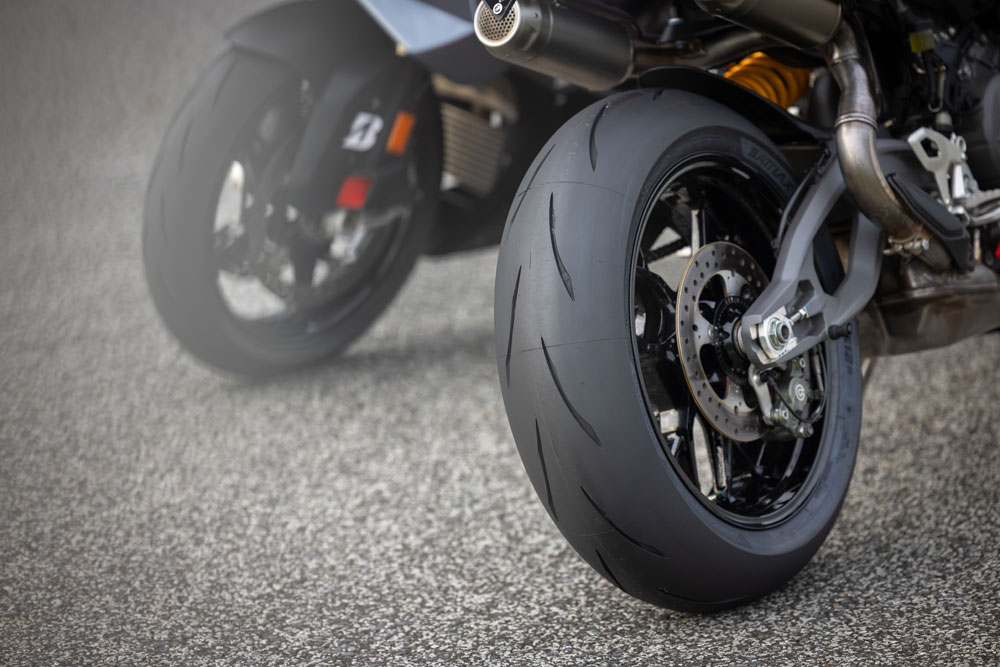
The new RS12 has three key factors over the RS11: a new compound, new tread pattern and the use of the HE-MS Belt (High Elongation Mono Spiral belt) structure, a first for a production/street-legal tire.
Bridgestone has utilized its race-developed 3LC compound, with a harder center for longer road miles and softer shoulders for a wider footprint and thus better mid-corner stability, especially when at full braking force and during the transition when the throttle is first applied, and the load is gradually taken off the front tire and transferred to the rear of the bike.
In comparison to the front, the rear tire has a slightly wider hard center compound to deal with the copious amounts of horsepower modern superbikes produce.
Where the RS12 differs visually from the RS11 is in its new tread pattern. Gone are the RS11’s side grooves that run from the edge of the tire to a quarter of the way across the compound, replaced instead by more slick rubber.
This can have the negative effect of reduced wet-weather dispersal but further highlights the RS12’s race nature—more tire on the ground means more grip and better acceleration. If you want better wet-weather performance, you should probably have a look at the Battlax S23, a tire we love here at Cycle News and have put on several test bikes over the last two years.
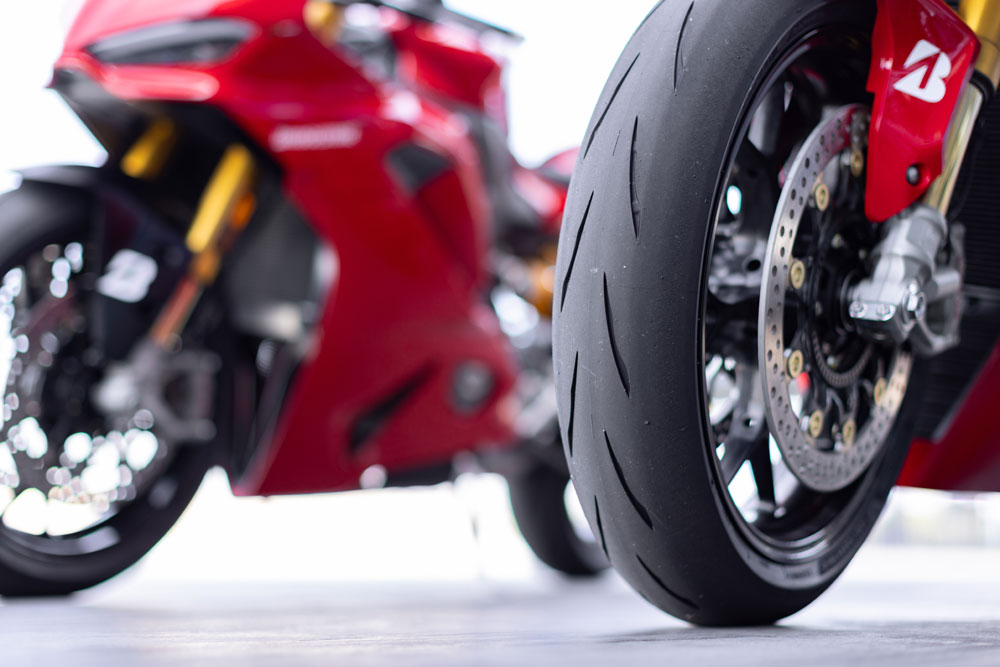
However, the most interesting and beneficial aspect of the RS12’s construction is the HE-MS Belt in the front tire. Engineers have developed the HE-MS Belt to allow for a tighter twist pitch, essentially compacting the belt around the tire carcass and creating a more uniform structure that distributes braking pressure more evenly across the tire’s surface.
The result at the handlebars is greater braking force can be applied as the tire tread spreads out over the road surface more evenly, giving you greater feel and thus more confidence.
On the all-important spider graph (tire companies love a good spider graph), Bridgestone claims the RS12 is superior everywhere in comparison to the RS11, with the main advantages coming in front and rear grip feel and performance drop feeling, with small improvements made in the important mid-corner brake release feel, cornering stability and in reduced warm-up times.
Lowdown | Bridgestone Battlax RS12 Tires
Standout Feature: Exceptional front tire performance, especially under braking
SIZES: |
Four sizes (1 Front, 3 Rear) |
| Front | 120/70ZR17M/C(58W)TL |
| Rears | 180/55ZR17M/C(73W)TL |
| 190/55ZR17M/C(75W)TL | |
| 200/55ZR17M/C(78W)TL |
VIDEO | Bridgestone Battlax RS12 Track Test
Rider Analysis | Bridgestone Battlax RS12 Tires
Bridgestone’s Battlax RS11 was about as close as you could get to a race-bred tire for the street, but the new RS12 aims to take it up a few notches.
The Chang International Circuit in Buriram, Southern Thailand, is one of the newest MotoGP venues. Its 1.9-mile venue first hosted Marc and the boys in 2018, so compared to some of the circuits we normally ride around the world, it’s practically brand new, which makes it ideal for testing race-bred tires.
The asphalt around Chang International Circuit is billiard table-smooth and thus allows you to really push the front-end under braking, but this wasn’t the first thing that I noticed.
That accolade belongs to the RS12’s incredibly quick warm-up performance. With no tire warmers in use on the RS12, it took about three-quarters of my out lap to have my knee buried into the tarmac, a good sign as the tire’s predictable behavior allowed me to push for faster lap times earlier than I expected.
Once the tire was fully up to temperature and I could brake at the points on the track I felt comfortable and repeatable at, the front tire’s stability really shone through.
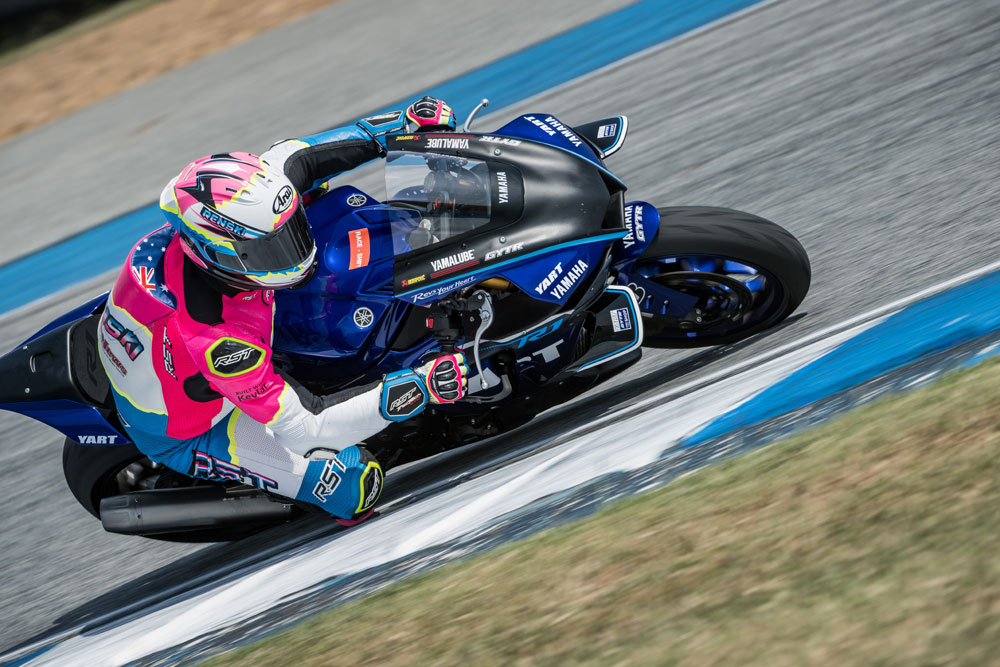
While not having quite the squishy feel of a pure race tire, the RS12’s late-braking stability made for predictable turn-in feel at the handlebars regardless of whether I was on a race-prepped Yamaha YZF-R1, a CBR1000RR-R SP or a BMW S 1000 RR.
Once in the middle of the corner, the transfer from full brakes to early throttle opening again inspired confidence. The rear RS12’s edge grip was impressive, allowing me to dial in the power smoothly for the first 10 laps, at which point drive began to slowly diminish as heat build-up slowly robbed the tire of edge grip.
This is to be expected with a standard street tire, albeit a racing version. The RS12 still proved to be a very impressive unit, with each set of tires lasting upwards of 60 laps around the high-speed circuit, even if that incredible initial grip began to fade after about 10 laps.
Bridgestone’s tires are more in line with Dunlop in that they have a harder carcass and less squish than something like a Pirelli or Michelin. The result is a stiffer tire that you need to trust a bit more than a Pirelli, which almost screams at you, letting you know exactly what it’s doing.
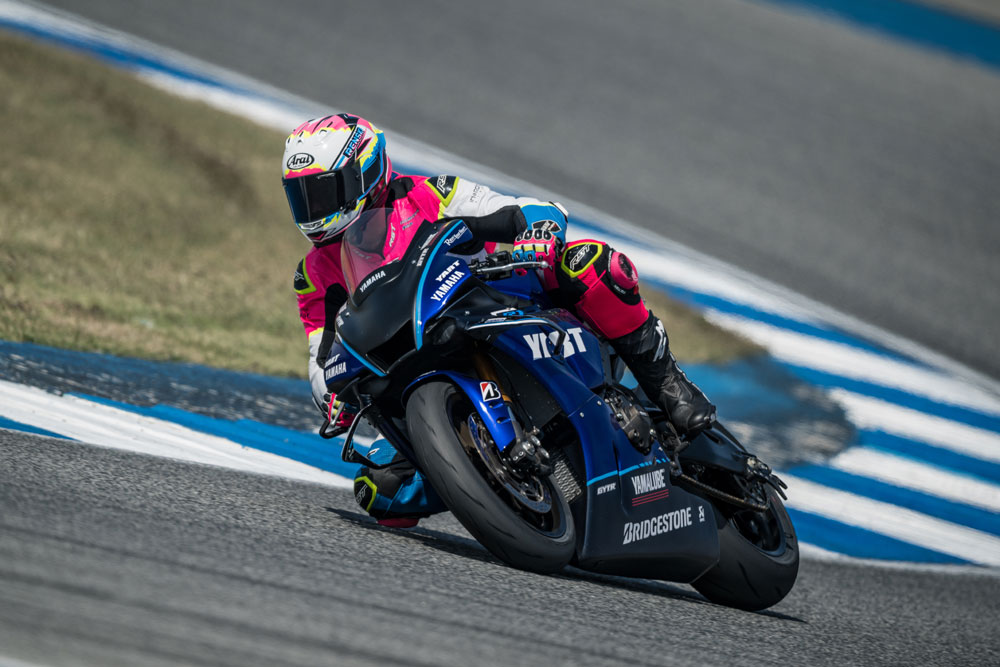
That’s not a bad thing, however, as Bridgestones seem to be (at least in my opinion) the best of both worlds in that you get incredible grip but with a slightly less tangible feel than Michelin or Pirelli. They will almost be guaranteed to last longer than all those brands, too.
The RS11 was a good tire, but the RS12 is a firm step ahead in all areas of relevant performance. There are only two areas I can’t comment on—big mile longevity and wet-weather performance. I guess I’ll have to get a set on a long-term test bike this year to find out.CN
For more information, visit bridgestone.com
Click here to read the Bridgestone Battlax RS12 Tires Review in the Cycle News Digital Edition Magazine.
Click here for more New Products on Cycle News.