Cycle News Archives
COLUMN
Watershed Moment
By Kent Taylor
There can be no debating that Ducati is the current king of motorcycle road racing. Having won four consecutive MotoGP World Championships (using three different riders to accomplish the task), it cannot be disputed that the road to victory runs right through the Borgo Panigale District of Bologna. Toss in their six consecutive World Constructors’ Championships, and the conversation now turns to the discussion of who is second best.

Though Ducati singles had been racing and winning for many years, the company’s success in the world of big bikes really began in 1972, when Paul Smart and Bruno Spaggiari rode the new V-twin 750s to the top two spots in the Imola 200. Later, in 1978, Mike Hailwood made a triumphant return to motorcycle racing when he won the Isle of Man TT aboard a Ducati. In between those major international wins, a couple of motorcycle magazine journalists, Cycle Magazine staffers Cook Neilson and Phil Schilling, gave the brand its first major victory in American road racing when Neilson won the 1977 Daytona Superbike Production class.
It would be more accurate to state that Schilling and Neilson spearheaded a winning effort, for this was a project that in Neilson’s words enlisted the services of “all of our go-fast friends in Southern California.” A motorcycle that was made in Italy was remade in the USA, with every metal bit undergoing a rebirth that would make a good motorcycle a great racer. To what extent was this Ducati transformed? When the build was finished, “there were no standard parts on this motorcycle,” Neilson recalls.
“The first time we [Cycle Magazine] ever had a chance to ride a 750cc V-twin Ducati was at Bridgehampton Raceway [near Sag Harbor, New York] in 1971,” Neilson recalled. “Phil Schilling and I were invited to see what we thought of this new Ducati. After spending four or five hours on this motorcycle, we knew it was something unique.”
The magazine editors would later purchase two of the first production 750s, with the sole intent of converting them into race bikes. When the work was done, the Ducati still looked like a product from Bologna but in reality, was about as Italian as Tom Jones.
“All of the internal engine parts were remade for us by our go-fast friends in Southern California. We had to have a special transmission made for it because it kept destroying the transmission gear teeth. We called on a guy named Marvin Webster, who used to make gearboxes for Indy race cars up in San Jose. He built two vacuum-remelt steel gearboxes for this bike. It cost me $2000—and they were probably worth $50,000.
“We got that kind of help from everybody,” Neilson adds. “To call on all of this talent—that was what made this so much fun.”
There was more trickery on this motorcycle than could be found in Harry Houdini’s storage closet. Titanium axles and nuts were custom-made for the machine. The rear brake caliper, originally aluminum, was remade in magnesium. Morris Mag wheels were also purpose-built, and the aluminum discs were plasma-sprayed, providing a tougher surface that better withstood heat. The front brake caliper even had to be sourced from Japan (borrowed, as it were, from a Honda)!
The Superbike class was still more of a halftime show in AMA professional road racing in the 70’s. Kenny Roberts, Gary Nixon, Steve Baker and other legends were still the stars of the show on their works machines. The production-based Superbike class was still being sorted out—as were the rules of engagement. Neilson admitted the Ducati had “some interesting parts, which the AMA was uninformed of [and] that was fine with us!”
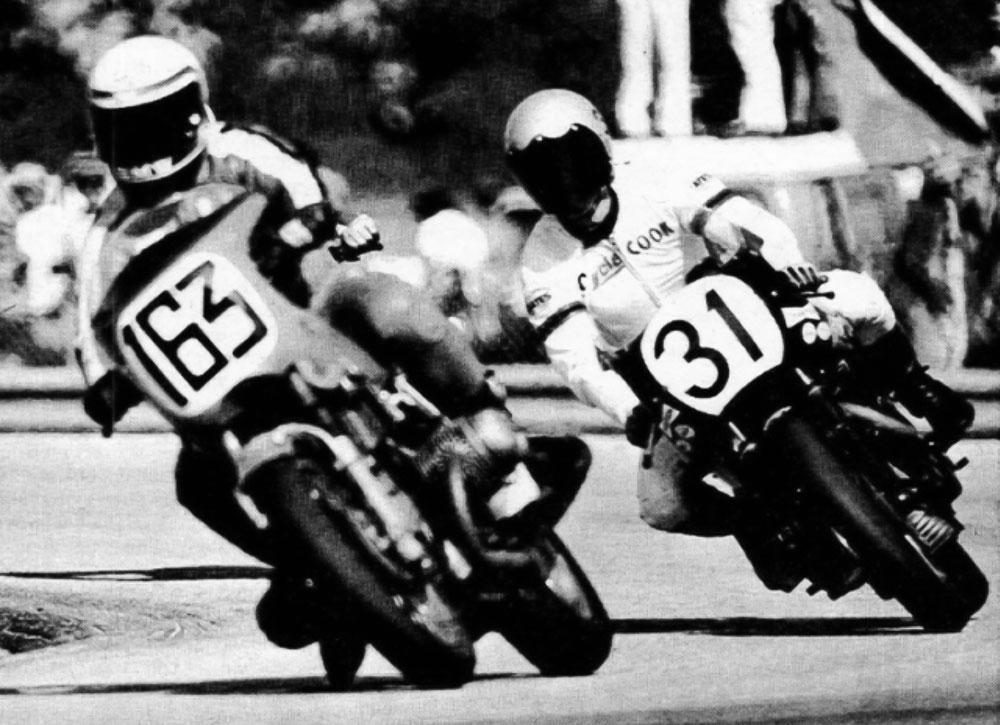
The Cycle effort had finished a strong third in the 1976 Daytona Superbike race, with Neilson trailing Steve McLaughlin and Reg Pridmore in the main event. Twelve months later, the duo had honed the machine into winning form and, according to Cycle News, second place wasn’t even close.
“Neilson was running two seconds a lap faster than anyone else in practice,” wrote CN. “The Ducati, which made 90.4 horsepower on C.R. Axtel’s dyno in California, was the lightest and best-handling machine in the race.”
When the green flag fell, future champion Wes Cooley led, whipping every pretty pony from his massive Yoshimura Kawasaki 1000. Neilson and Cooley battled briefly, but the Ducati rider took the lead for good on lap two of the race. An event described by Cycle News as “the usually-close Superbike Production class” was now a one-man show, as Neilson and the bike (which would soon be known as “The California Hot Rod”) Desmo-ed their way to victory. Cook probably had enough time to light a cigarette and sip a Johnnie Walker Blue before second-place David Emde crossed the line, a full 30 seconds later.

Nearly 30 years later, Neilson reflected on the Daytona win as something of a watershed moment for Ducati. “I think that if that had been its only success, nobody would’ve cared. The fact that Ducati went on to compete at the highest level, internationally and in this country, makes what we did more viable. I consider myself lucky to have stumbled upon this motorcycle at Bridgehampton Raceway.” CN
VIDEO | Cycle News Archives – Ducati’s First Road Race Win In America
Click here to read the Archives Column in the Cycle News Digital Edition Magazine.
Subscribe to six decades of Cycle News Archive issues
Click here for all the latest Road Racing news.

