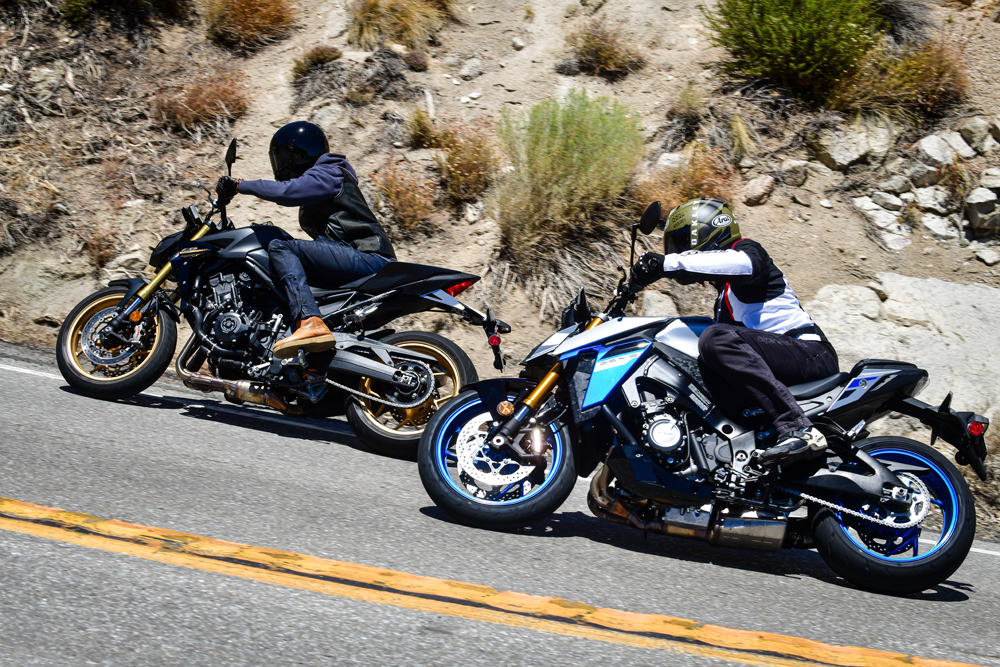
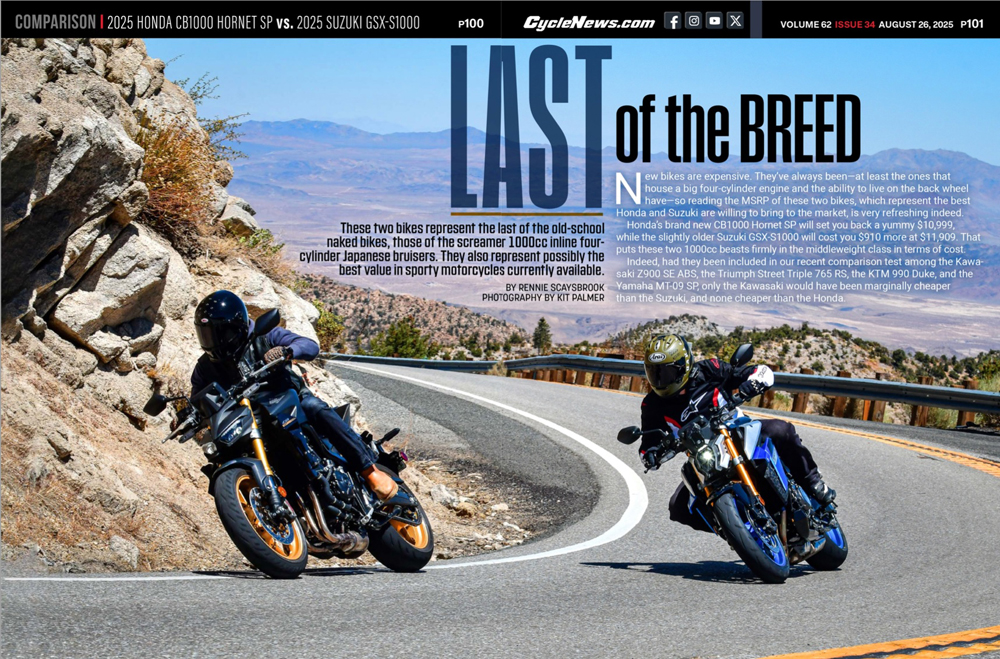
These two bikes represent the last of the old-school naked bikes, those of the screamer 1000cc inline four-cylinder Japanese bruisers. They also represent possibly the best value in sporty motorcycles currently available.
Photography by Kit Palmer
New bikes are expensive. They’ve always been—at least the ones that house a big four-cylinder engine and the ability to live on the back wheel have—so reading the MSRP of these two bikes, which represent the best Honda and Suzuki are willing to bring to the market, is very refreshing indeed.
Honda’s brand-new CB1000 Hornet SP will set you back a yummy $10,999, while the slightly older Suzuki GSX-S1000 will cost you $910 more at $11,909. That puts these two 1000cc beasts firmly in the middleweight class in terms of cost.
Indeed, had they been included in our recent comparison test among the Kawasaki Z900 SE ABS, the Triumph Street Triple 765 RS, the KTM 990 Duke, and the Yamaha MT-09 SP, only the Kawasaki would have been marginally cheaper than the Suzuki, and none cheaper than the Honda.
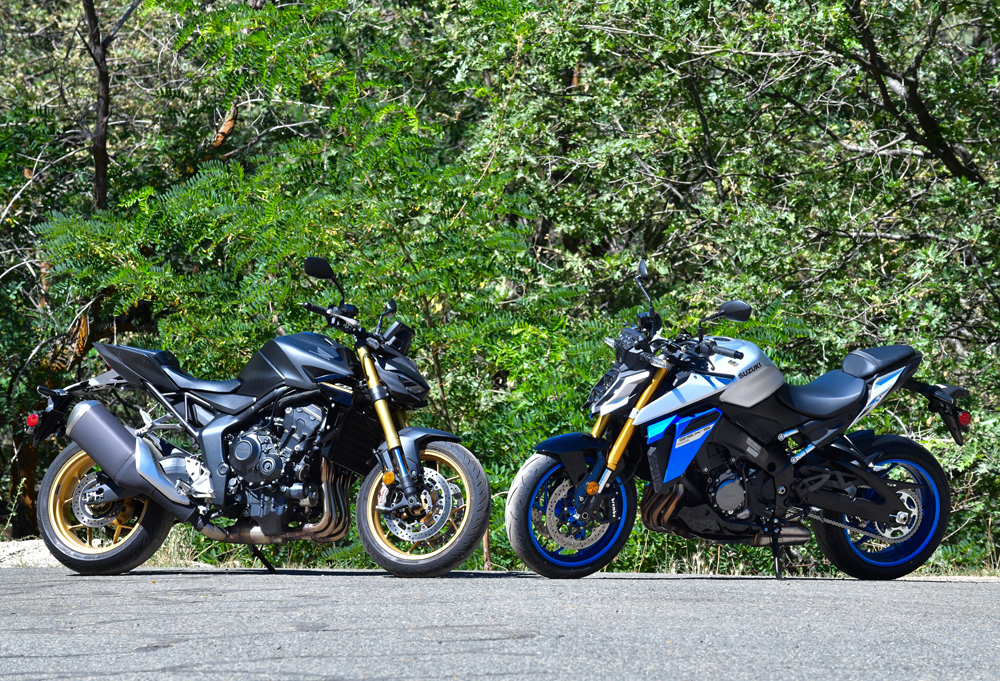
The CB and GSX also represent the last of what was ubiquitous among the Japanese—1000cc screamer inline four-cylinder engines wrapped in naked-bike chassis. The Yamaha MT-10/MT-10 SP also runs a 1000cc four-cylinder, but its big bang/crossplane crank make it a different animal to the Honda and Suzuki. And it’s a lot more expensive at $14,799 for the base MT-10 and $16,999 for the SP.
So, what better way to unpack these two modern dinosaurs than by putting them head-to-head? Seems like the thing to do. And we did.
The New Kid | Honda CB1000 Hornet SP
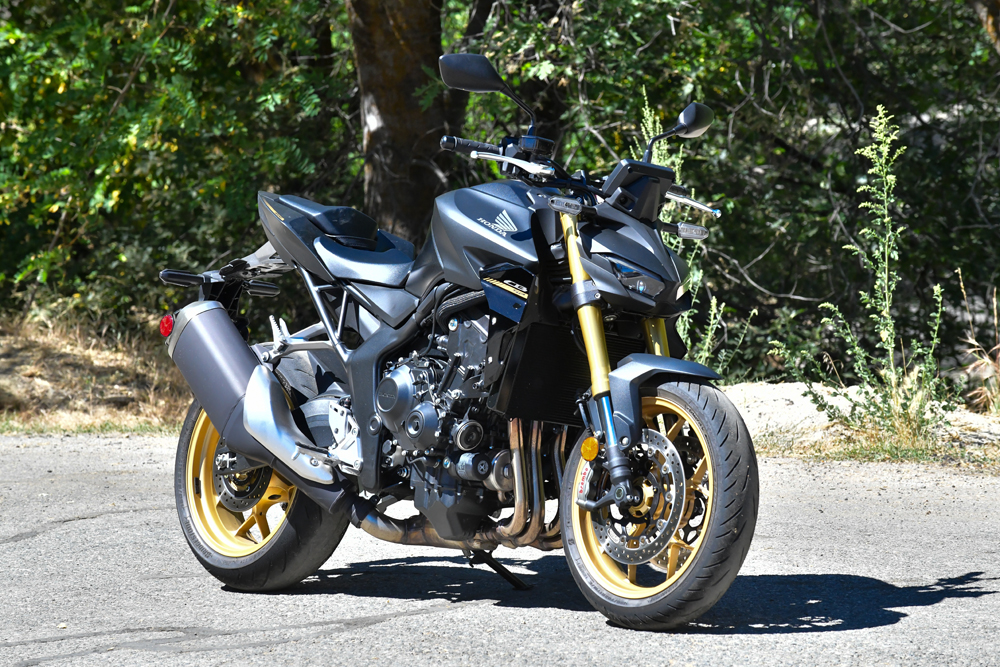
The new kid on the block is Honda’s 2025 CB1000 Hornet SP. Based on the 2017 Honda CBR1000RR Fireblade, Honda claims 155 horsepower and 78.9 lb-ft of torque at 9000 rpm from that inline four with all the good stuff—five adjustable ride modes with two custom maps, adjustable engine-brake control, up-and-down quickshifter, ABS, and quality suspension and brakes from Öhlins and Brembo. Notice how we said “claims 155 horsepower” in italics? There’s more to that, which we’ll get to in a minute.
Honda still sells (at least in North America) the CB1000R Black Edition for $12,999, but that bike is effectively a 2018 model, so all the marketing push is now directed toward the Hornet.

Back to the new kid. The CB’s tubular steel chassis hardware is impressive: Up front, you get a fully adjustable 41mm Showa SFF-BP fork, and out the back, Honda’s gone for the bling and fitted an Öhlins TTX36 shock that is also fully adjustable.
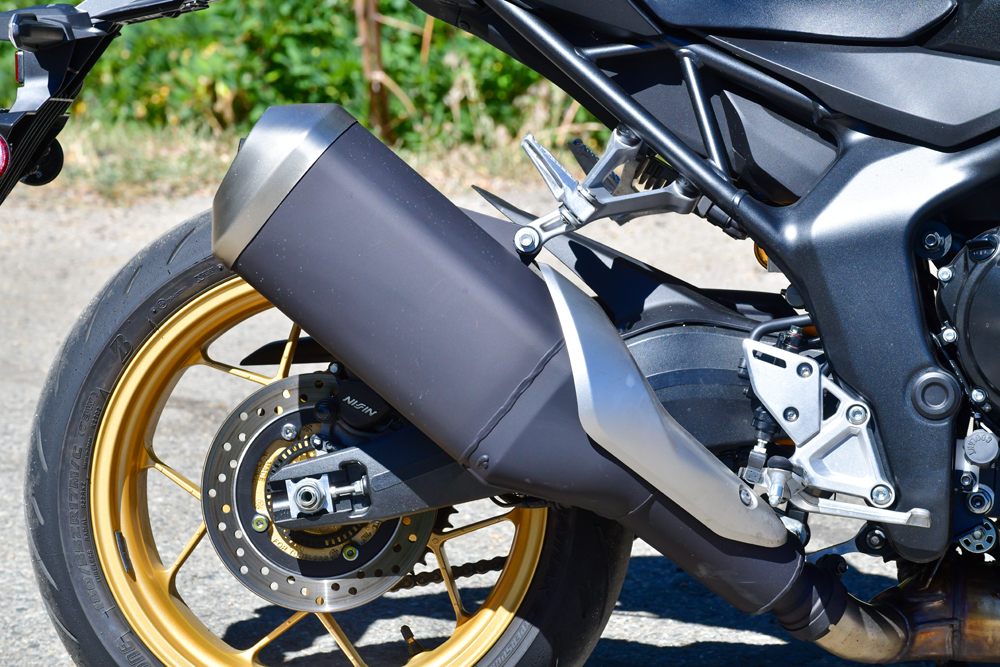
There’s also a bit of Honda style thrown in with the sexy five-spoke Y-shaped gold-painted cast alloy wheels wrapped in Bridgestone Battlax S22 rubber, and brakes are now proper superbike-spec Brembo Stylema dual four-piston radially mounted calipers up front, even if discs are a bit on the small side at 310mm. Rubber brake lines also save a few dollars at the dealer. A single-piston Nissin caliper grips a 240mm disc at the rear.
We weighed the Honda at 465 pounds with a full 4.5-gallon tank of gas (bang-on what Honda says it weighs in the specs), and the Honda came back with a 50.6/49.4 front-to-rear weight distribution.
As for electronics, they are of the old-school type (read: no Inertial Measurement Unit). This is far from a drawback given the fact the CB—and GSX, for that matter—are not trying to be the biggest and baddest in the category like the Ducati Streetfighter V4 S and the BMW M 1000 R. No IMU saves costs and, honestly, do you really need IMU-fettled slide and traction control on your commuter street bike? I don’t, either.
Regardless, the Honda has four-level traction control (1-3 plus off) with the wheelie control integrated, basic ABS, and the five-inch TFT dash uses Honda’s free RoadSync app for Android or iPhone. This allows you to pair your phone to the bike via Bluetooth for turn-by-turn navigation, music, calls and more. While the system works best with a headset, riders can still use visual nav cues without one.

You do get a handy USB-C charging port under the seat for your phone, but there’s no cruise control and no heated grips, although you can buy some for $157.95 (do a bit of haggling at the dealer and we’re positive you’ll get them for free).

The Old Dog | Suzuki GSX-S1000
On the other side of the ring is the Suzuki GSX-S1000, a model that was renewed back in 2022 but can trace its heritage back to the original GSX-S of 2015. The lineage runs even deeper than that, with the 2025 GSX’s 999cc inline four-cylinder motor derived from Suzuki’s king of kings in the 2005 GSX-R1000 superbike.
Suzuki doesn’t publish claimed horsepower and torque numbers for the GSX, but the 2022 model (which is the exact same as this model, bar colors and the dash) pumped a claimed 149 horsepower at 9250 rpm and 78 lb-ft of torque at 9250 rpm (there’s those italics again).

As for the twin-spar aluminum chassis hardware, it wouldn’t be a Suzuki without KYB suspension, and that’s what you get in the 43mm inverted fork and monoshock, the former fully adjustable while the latter comes in a slightly lower spec with preload and rebound damping adjustment.
Up front, you’ve got Brembo M4.32 four-piston radially mounted calipers clamping, like the Honda, two 310mm discs. At the rear is a Nissin single-piston caliper clamping a 250mm disc.
When we put the Suzuki on the scales, it returned a figure of 473 pounds with a topped five gallons of California’s finest (half a gallon more than the Honda). As for weight distribution, the Suzuki was slightly more front-heavy than the Honda, with 50.9 percent of its weight on the front wheel and 49.1 percent on the rear.

Again, like the Honda, the electronics do not house an IMU; thus, you don’t get cornering ABS, traction control, slide control, or whatever else. Trust me, you don’t need it.
What you do get, like the Honda, is three-levels plus off traction control that has the wheelie control integrated, three engine maps but no custom maps via the trusty Suzuki Drive Mode Select (SDMS) platform, and an up and down quickshifter for the six-speed gearbox. There’s no cruise control and no heated grips, although you can get them for the rather hefty price of $499.95 at the Suzuki dealer.
One of the disappointments with the 2022 GSX-S was the woeful dash that looked like something from the Game Boy era, but Suzuki thankfully listened to rider complaints and has fitted an excellent, full-color 6.5-inch TFT that’s far easier to use and navigate.

Thus, you can utilize the Suzuki mySPIN app to pair your phone via Bluetooth to the GSX, letting you make and receive calls, access your contacts, listen to music and use turn-by-turn navigation.
Sadly, Suzuki missed a big trick by not fitting the GSX with a USB/USB-C charging port, so if you’re running maps or music on your ride, you only have the amount of charge on your phone available to you and can’t charge the phone on your ride. What an odd decision, especially considering the equally good GSX-S1000GT has a USB-C charging port.

Let’s go for a ride, shall we?
First, a couple of vitals. The Suzuki and Honda both share an identical seat height of 31.9 inches, although the Honda has a slightly smaller fuel tank at 4.5 gallons to the Suzuki’s five-gallon tank. Steering rake and trail figures are identical at 25° and 3.9 inches, and there’s only two-tenths of an inch difference in wheelbase between them, with 57.3 inches for the Honda and 57.5 inches for the Suzuki.
It is, therefore, rather eye-opening how different they feel when you first sit on them.
The Suzuki runs a softer, deep-dish padded seat with the tank edges rising higher around your legs, while the Honda is a flatter, almost bench-style seat with far less padding. A saving grace is that there’s a little more distance between the footpegs and the seat, so you get a little more blood flow to your lower leg extremities on the Honda than on the Suzuki.
You sit much more in the Suzuki than on it. The Honda, on the other hand, has shades of a dirt bike supermoto stance to it.
After messing around with the various riding modes to feel the different power delivery on each bike, we opted for the full power modes and left them there for the rest of the test, and here’s where things got interesting.
Honda claims 155 horsepower out of their CB. Granted, that’s crankshaft horsepower, but in practice, the Honda suffers big time, and we really mean big time, from the dreaded emissions restrictions placed on its motor.
From a closed-throttle opening that’s quite abrupt, the CB delivers torque in a clunky, uneven fashion. There’s a massive flat spot that begins just after 4000 rpm. Torque then jumps dramatically at 5000 rpm, falls again at 6000 rpm, and finally begins to build solid acceleration for the next few thousand revs. However, by the time the motor gets to 9000 rpm, drive falls off a cliff. Why is that?
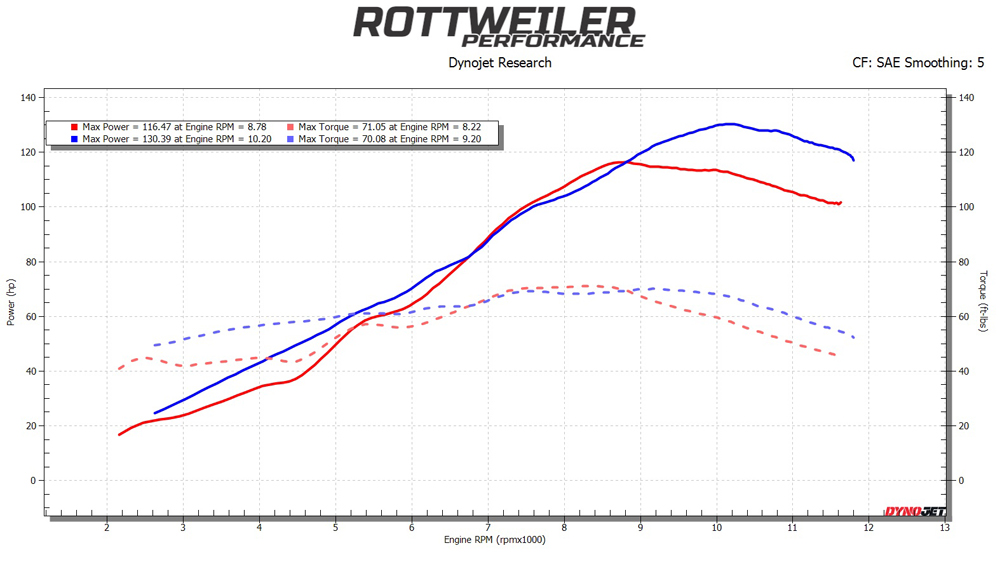
It’s due to the various emissions laws—both pollution and noise—that we must deal with in North America. A look at the dyno graph confirms everything we felt at the handlebars, and it’s not pretty.
We visited Rottweiler Performance in Costa Mesa and dyno’d the CB at a measly 116 horsepower at the tire. While we know Honda’s claimed 155 horsepower is crank horsepower, one could be forgiven for thinking we’d get at least 130-135 horsepower at the tire from a 1000cc, superbike-derived motor.
It is not entirely Honda’s fault, but other manufacturers have handled the emissions duties far better. The good news is you can get rid of most of the problems on the Honda with a simple ECU flash and an aftermarket exhaust muffler (you’d want a muffler regardless to give the CB a bit of bark to it). You might want to watch the in-depth videos from 2 Wheel Dyno Works in Washington and see how easy it is to uncork some good power (they dyno’d their CB at 121 horsepower, just for reference), but, just as importantly, a smoother torque curve from the Honda.
The Suzuki, on the other hand, has a far smoother initial throttle opening from fully closed, and it maintains its torque advantage (even though peak torque is only one pound-foot less than the Honda’s) right through the rev range.
The Suzuki has a real advantage below 7000 rpm with a smoother torque curve, and from 9000 rpm, where the Honda dies off, the Suzuki keeps on charging. We dyno’d the Suzuki at 130 rear-wheel horsepower, so about where you’d expect it, given claimed numbers of 149 horsepower at the crank.
More than straight numbers, however, from the handlebar, the Suzuki’s motor is much smoother in almost all the areas that matter. It also sounds far beefier with a trademark Suzuki induction roar matched to a raspy exhaust note from that stubby muffler.
We have no doubt you would be able to get at least 140 to 150 rear-wheel horses out of the Suzuki with a pipe and a tune, stuff that also wouldn’t ruin the bike’s pollution compliance.
A slight downside to this performance advantage is that the Suzuki used more fuel than the Honda, with our measurements coming back at 43.3 mpg for the Suzuki and 38.9 mpg for the Honda.
There’s very little to separate the two bikes on gearshift—both the CB and the GSX have nicely mapped quickshifters that make changes a breeze, so neither is easy to fault.
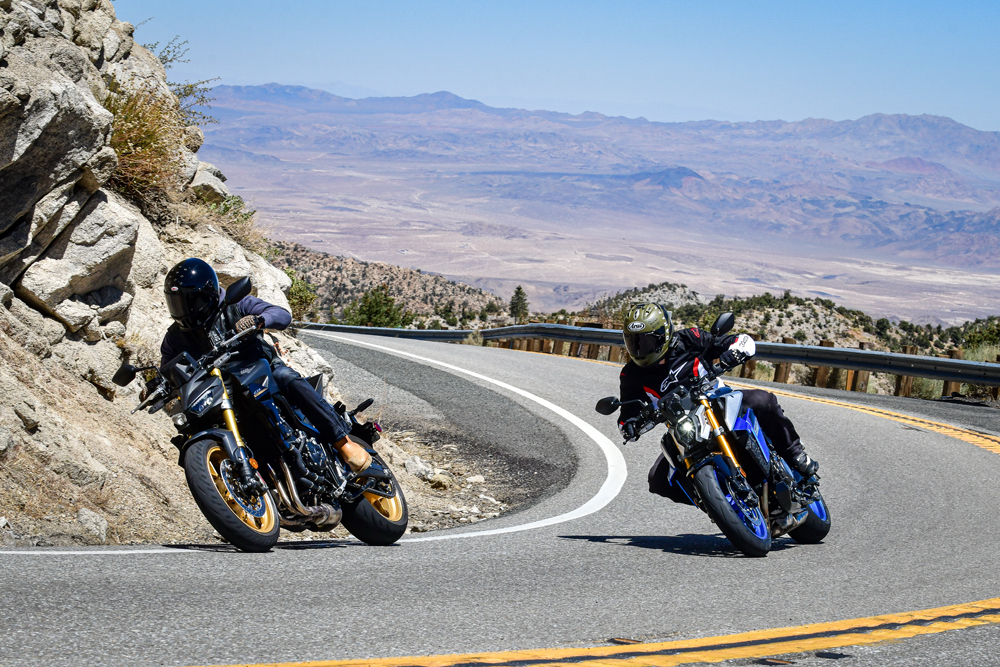
Start getting into the twisties and there’s more separation, although this time it’s much closer.
The CB’s flatter ergonomics allow you to get over the front a little more than the Suzuki, which lets you load up that front Bridgestone and make it turn sharper and quicker than the GSX. However, the Honda’s 41mm Showa SFF-BP fork doesn’t have quite the same feeling of solidity as the 43mm KYB unit on the Suzuki, especially under hard braking and turning. The Honda is a little nervous in the front end, something we tried to dial out by upping compression and rebound damping, but we felt it was more the nature of the Showa fork.
The Suzuki has more mechanical weight over the front end due to its more front-heavy weight distribution, which we saw earlier, and that helps it steer in a more stable, if not faster, fashion than the Honda. You could feel more of what the Dunlop Roadsport 2 front tire was doing with the Suzuki.
Where the Honda has a definite advantage is in the rear shock. You can feel more of what the back end is doing on the Öhlins-equipped Honda, with smoother initial bump absorption on crappy roads and more compliance under hard acceleration while cranked over than the lower-spec KYB unit on the Suzuki. The Suzuki isn’t bad by any stretch of the imagination, but the Honda has the edge here.
Comfort-wise, it’s like splitting hairs. Those who have a shorter inseam of 30 inches and under will probably find the Suzuki more comfortable over long rides, whereas taller riders will probably lean toward the Honda. One undeniable fact is that Honda’s thinner seat gets harder, faster, than the Suzuki’s plusher unit, so that’s something to bear in mind if you plan on doing some big days in the saddle.
Moving onto mission controls, and although the Honda has more gadgets you can adjust, the Suzuki manages the main stuff—like adjusting traction control and your chosen engine/ECU map—a little better.
The Honda has a neat little mode switch on the left handlebar, but Suzuki has laid out the information in an easier-to-read format. You can always change to one of three dash themes on the Honda, so that’s an advantage over the Suzuki.
As neither of these bikes comes with cruise control, nor the ability to buy it in their respective company’s aftermarket catalogs, that puts both bikes down a little in overall spec. At least you get a USB-C charger under the seat on the Honda—not having one on the Suzuki is nuts.
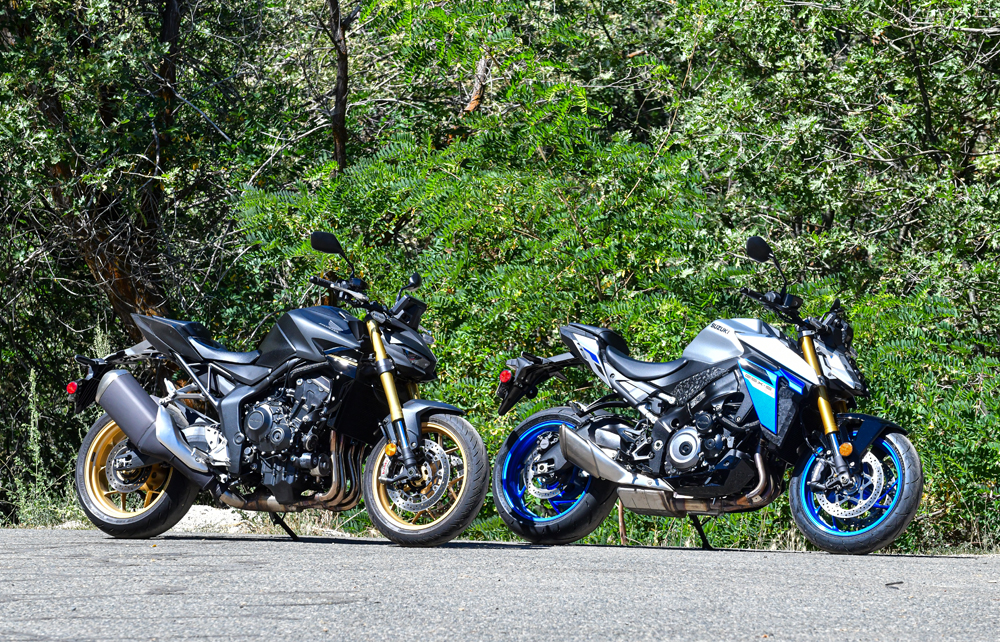
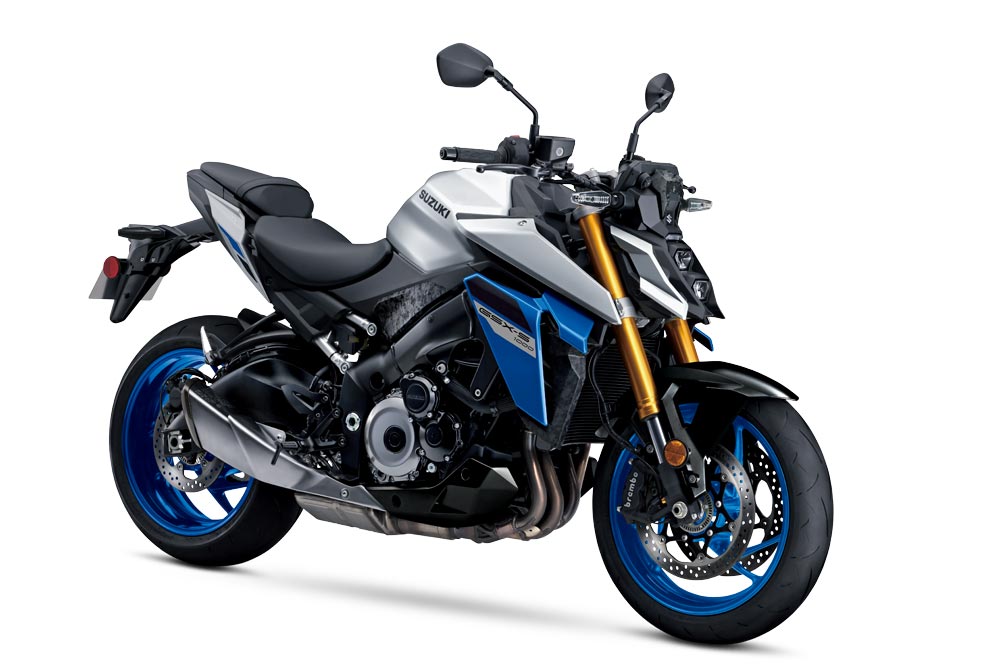
However, you can get more than one color on the Suzuki in the Metallic Matte Sword Silver of our test bike and the Glass Sparkle Black (which would look great with gold wheels. Wait a minute…). The Honda, at least in the U.S., only comes in the Matte Black Metallic option, yes, with gold wheels.
Conclusion | 2025 Honda CB1000 Hornet SP vs. 2025 Suzuki GSX-S1000 Comparison
Given what we’ve gone through here, we’ve got to give the nod to the Suzuki in this test. If the Honda wasn’t so clogged up on the emissions side, that could be a swing in the test, but because it is how it is from the factory and the fact that many owners (sadly) won’t go and visit a dyno tuner, the Suzuki gets our vote.
But, and it’s a big but, the Honda does come with some seriously good bits on it, considering the MSRP. Better front brakes and that Öhlins shock on the Honda are all things that would seriously up the price of the Suzuki if you were to add them when bought in the aftermarket. The Honda’s matte black is a little too black for us, but you can always go visit a graphics guy to add your personal bling to the Honda.
Regardless, the Suzuki, even though it costs a little more, is a hell of a bike for the price. It’s not perfect, especially given the lack of a USB-C and heated grips that cost nearly three times what they do on the Honda, but the ride is exceptionally good.
That K5-derived motor is a beast, they’ve fixed that god-awful dash from a few years ago, and it’s got almost all the electronics you’d want in a big-bore naked bike (aside from no cruise control, same as the Honda).
Both these bikes represent incredible value and really make you question whether the electronics arms race of the last few years has been worth it. These Japanese machines give you almost everything you need, and nothing don’t, but if we’re walking into the dealer to throw down our money, we’re taking the Suzuki. CN
VIDEO | 2025 Honda CB1000 Hornet SP vs 2025 Suzuki GSX-S1000


2025 Honda CB1000 Hornet SP Specifications
| MSRP | $10,999 |
| Engine | Inline 4-cylinder |
| Valvetrain | DOHC |
| Cooling system | Liquid |
| Displacement | 999cc |
| Bore x Stroke | 76.0 x 55.1mm |
| Compression Ratio | 11.7:1 |
| Measured Horsepower | 116 hp @ 8780 rpm |
| Measured Torque | 71 lb-ft @ 8220 rpm |
| Transmission | 6-speed |
| Fuel System | Fuel injection, ride-by-wire, variable throttle maps |
| Clutch | Wet, multiplate slip and assist |
| Frame | Aluminum twin-spar |
| Front Suspension | 41mm inverted Showa SFF-BP fork, fully adjustable |
| Rear Suspension | Öhlins TTX36, fully adjustable |
| Front Brake | Brembo Stylema M4.30 radial-mount 4-piston calipers, 310mm floating discs, ABS |
| Rear Brake | Nissin single-piston caliper, 240mm disc, ABS |
| Front Front | 120/70-17 in. |
| Rear Tire | 180/55-17 in. |
| Rake | 25.0° |
| Trail | 3.9 in. |
| Wheelbase | 57.3 in. |
| Seat Height | 31.9 in. |
| Fuel Capacity | 4.5 gal. |
| Weight (wet, measured) | 465 lbs. |
2025 Suzuki GSX-S1000 Specifications
| MSRP | $11,909 |
| Engine | Inline 4-cylinder |
| Valvetrain | DOHC |
| Cooling system | Liquid |
| Displacement | 999cc |
| Bore x Stroke: | 3.4 x 59.0mm |
| Compression Ratio | 12.2:1 |
| Measured Horsepower | 130 hp @ 10,200 rpm |
| Measured Torque | 70 lb-ft @ 9200 rpm |
| Transmission | 6-speed |
| Fuel System | Fuel injection, ride-by-wire, variable throttle maps |
| Clutch | Wet, multiplate slip and assist |
| Frame | Tubular steel |
| Front Suspension | 43mm inverted KYB fork, fully adjustable |
| Rear Suspension | KYB monoshock, preload and rebound damping adjustable |
| Front Brake | Brembo M4.32 radial-mount 4-piston calipers, 310mm floating discs, ABS |
| Rear Brake | Nissin single-piston caliper, 250mm disc, ABS |
| Front Tire | 120/70-17 in. |
| Rear Tire | 190/50-17 in. |
| Rake | 25.0° |
| Trail | 3.9 in. |
| Wheelbase | 57.5 in. |
| Seat Height | 31.9 in. |
| Fuel Capacity | 5.0 gal. |
| Weight (wet, measured) | 473 lbs. |
Click here to read the 2025 Honda CB1000 Hornet SP vs. 2025 Suzuki GSX-S1000 Comparison in the Cycle News Digital Edition Magazine.
Click here for the latest Cycle News Naked motorcycle reviews and news.
Click here for more Honda motorcycle reviews and news.
Click here for more Suzuki motorcycle reviews and news.