There are so many choices available to parents to get their kids into motorcycling right now it’s quite bewildering.
Back in the day, you would buy a cheap little runabout two-stroke dirt bike to teach your kids the ropes on a trail or your local track. Now, with the rise of electric power, has come an incredible array of bikes from a range of manufacturers most people have never heard of, so it’s nice when a longtime brand like Kawasaki puts their hat in the ring.
By Rennie & Harvey Scaysbrook | Photography by Rennie Scaysbrook
That last point is particularly poignant. Kawasaki is the only one of the four major Japanese manufacturers that has recognized and invested in this emerging kids’ electric bike market. They wouldn’t release something unless it was worthy of the name, especially when a first bike and possible lifetime brand loyalty are at stake.
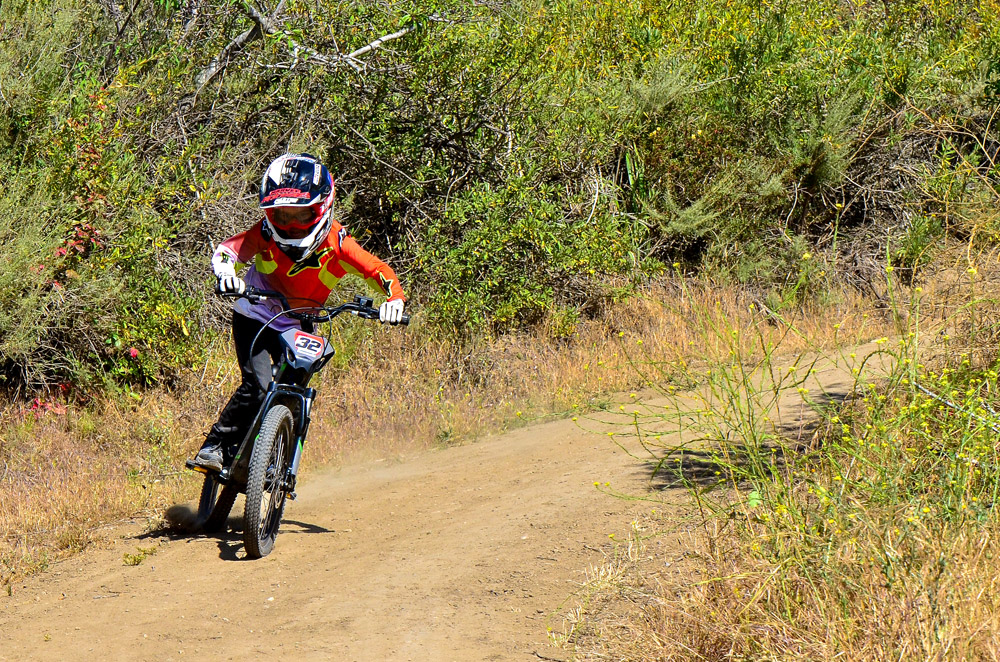
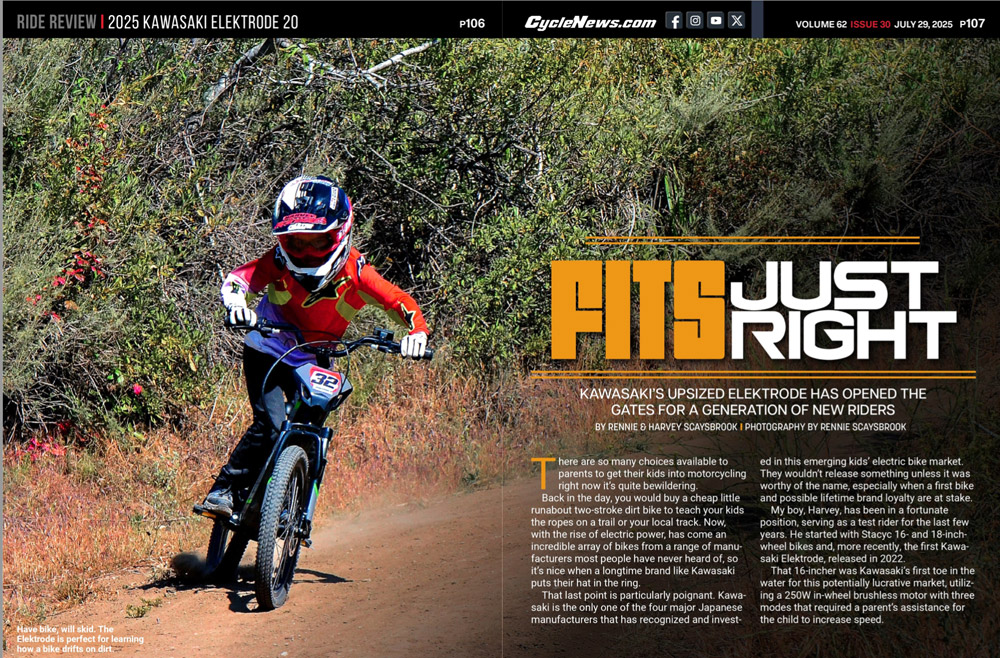
My boy, Harvey, has been in a fortunate position, serving as a test rider for the last few years. He started with Stacyc 16- and 18-inch-wheel bikes and, more recently, the first Kawasaki Elektrode, released in 2022.
That 16-incher was Kawasaki’s first toe in the water for this potentially lucrative market, utilizing a 250W in-wheel brushless motor with three modes that required a parent’s assistance for the child to increase speed.
Fast forward a couple of years, and after the success of the first Elektrode, the big boy 20-incher has landed. It’s available in two forms, one with front suspension and one without, although curiously they have the same retail price at $2199.

The same in-wheel electric motor resides in the Elektrode 20, its capacity boosted threefold to 750W (one horsepower). It is significantly faster than the 16-incher. It’ll go 13 mph in slow mode and 24 mph in both medium- and high-power modes, with the high mode having a more direct throttle response.
The battery is a frame-mounted lithium-ion unit with a capacity of 50.4V and 10.2 amp-hours. Kawasaki states you’ll get about an hour’s ride in the high and mid ranges and three hours on the low range.
If you run the bike fully flat, it will take approximately four hours to charge on a 110V AC outlet, using the charging connector located on the underside of the frame. If you’ve only got about an hour to go for a ride, you can charge it for about 20 minutes from flat and still get a decent ride in.

I’ll admit to being a tad concerned about the speed the little single-gear 20 can go; 24 mph is not that fast, but when you have a skinny 7-year-old on board, the Elektrode will get there quickly.
As a result, Harvey is restricted to the middle range of throttle, which seems about right for both slow-speed trail riding and higher-speed ripping around places like soccer fields.
The range depends entirely on how your kid rides the 20. If Harvey holds the thing flat out, he’ll get around 45 minutes of run time in the medium mode. Slow-speed riding, like the trials he practices each day on the way to school, will yield a lot more than that, and I’ll be honest and admit we haven’t totally measured how long it will take to deplete the battery on slow-speed, medium-throttle riding.
What I can tell you is he’ll get a week between charges, with each riding session lasting about 10 minutes between home and school.
The three modes can be changed easily when the bike is stopped with just a push of a button on the screen mounted on the left ’bar, which is both good and bad. Good due to ease, bad because, unlike the 16-incher, there’s no safeguard that can stop the kid from changing it themselves, so you’ll have to trust that they will keep it in the mode you, as the parent, choose.
The 20-incher is a much bigger proposition than the 16. Scale the difference between an 85cc and a 125cc dirt bike, and you’ll get the idea. You’ve now got a non-adjustable, braced bicycle-style 28mm fork that will give you two inches of wheel travel, while the back end is a hardtail, a bit like mid-level mountain bikes.
The 20-incher gets a front brake compared to the 16’s rear-only setup. They are mechanical style with a cable with 160mm discs front and rear. The brakes feel a little bargain basement but having that mechanical setup means no messing around with fluids when your kid crashes and flips the bike, as they inevitably will. It’ll still pull a stoppie if the front lever is pulled hard enough.
On the other end are the foot controls, which are essentially fat bicycle pedals that rotate and allow the rider to weight the bike easily in different riding styles. They also fold up in a crash.

Tires come in the form of IRC bicycle units, which can run pressures upwards of 35-40 psi but are happiest around the 30-psi mark if you plan on riding both loose dirt and hardpack ground.
A good reason the Elektrode 20 is a handy thing for kids is that you can change the handlebar height as the rider grows. That way you won’t be (hopefully) buying a new bike every other year until your kid becomes a teenager.
Harvey was 47 inches tall when he first got the 20, and he found it a tad big. Now that Harvey has grown a couple of inches, he fits right into it, and we can start to raise the seat height to accommodate, the range of which is 21.6-27.3 inches. As it is now, I don’t know the height he has it set, because he prefers it lower so he’s always on the pegs, a bit like his BMX.
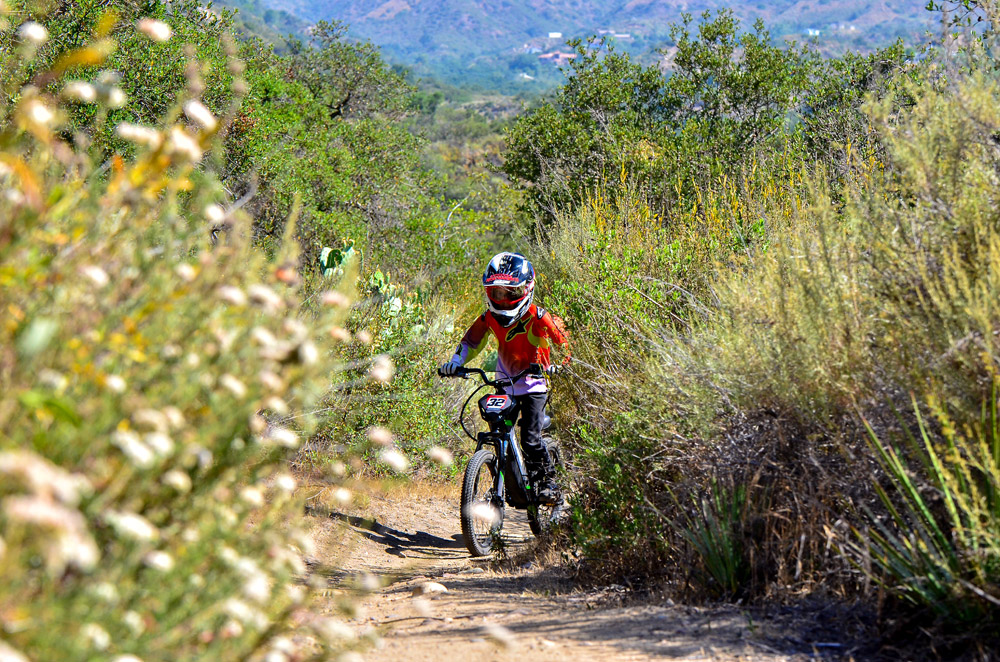
That’s where this bike really shines. Harvey loves the slow-speed maneuvering that comes with trials riding, and the fact that he has a little trail that he can ride to school on means the 20 gets used every day. Single. Day.
Kawasaki has done an exceptional job of mapping the throttle in the lower two modes, so it is not overly aggressive in the first 25 percent of application. That, in turn, gives the little rider confidence and makes them want to come back for more.
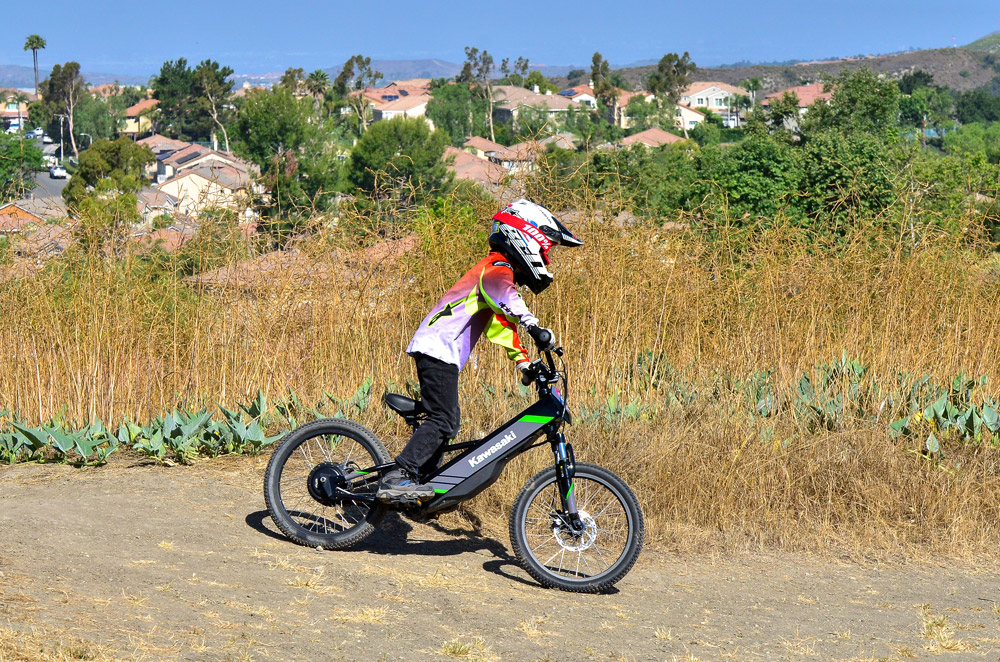
Harvey found the power delivery to be more than manageable for his experience level, but I feel that the better benefit of the 20-inch is the greater range of movement afforded by the larger frame. The bike weighs 46 pounds, so it’s not exactly a featherweight, but the weight is centered just right for little riders, allowing them to explore the limits of what the bike can do.
Kawasaki says the Elektrode 20 is for kids 8 and up, although I put Harvey on it a few months after he turned 7 and he was fine. Granted, he’s got a lot of experience on bikes for his age, so if your youngster is just starting out, at least wait until the recommended 8 years old or stick with the slowest mode because the high/full power mode is seriously quick for a kid’s bike.
I’ve ripped on about Super73s and Surrons of late, with kids riding them in a manner that seriously damages the perception of powered two-wheel vehicles, but I feel kids riding bikes like Stacycs and Elektrodes in parks and on trails (under supervision, of course) is a little different.
These bikes teach kids how to ride. They are motorcycles, not pedal-assisted electric bikes where the riders have next to zero intention of ever becoming real motorcyclists.
The Elektrode 20 is about as close to a zero-maintenance motorcycle as you can get. There’s no chain to lube or adjust thanks to the hub-mounted rear motor; however, this means it can be a pain to fix flats, as removing the rear wheel requires some effort.
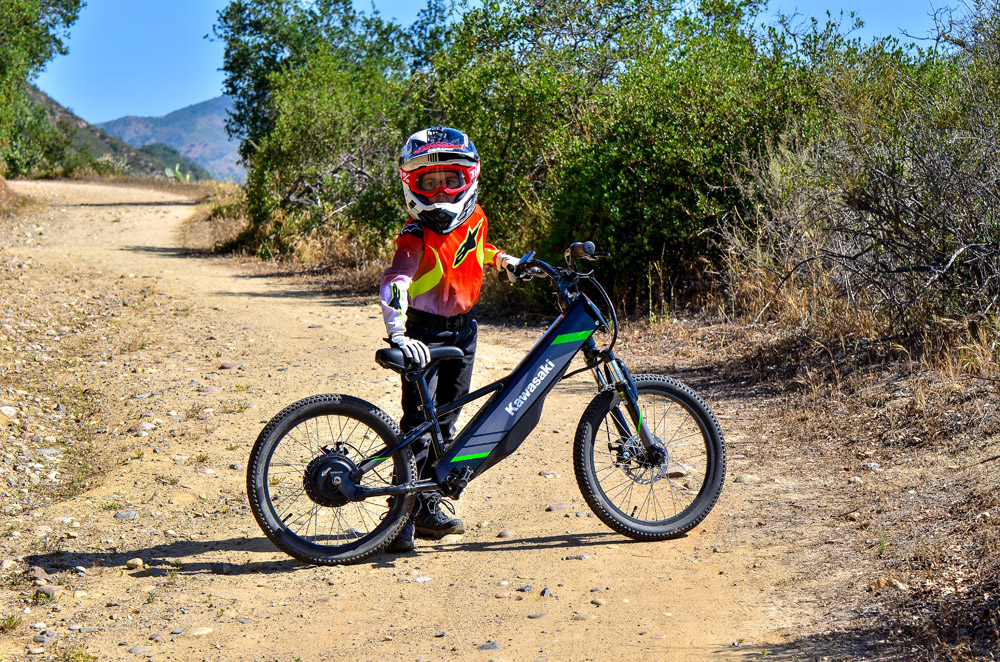
The brakes, while basic, teach the principles of front brake/dual brake use, and the bike is light enough that a 7-year-old can easily handle it if it tips over.
Kawasaki has given you a 12-month warranty for the frame, fork, handlebar, front wheel/axle/nuts, number plate, brake lever, seat post, seat clamp and frame under cover. Meanwhile, important components like the battery, rear wheel motor, charger, and controller are covered for 90 days. Other bits like the seat, footrests and brake calipers (and more) only get 30 days.
At $2199, it’s on the pricier side for a kid’s bike, but the fact it’s made by someone like Kawasaki gives me a bit of confidence in the Elektrode’s longevity. Harvey can ride it most places without annoying anyone. He thus gets way more riding time than I did as a kid, and motorcycling as a whole has a new rider it can count on in the future.CN
VIDEO | 2025 Kawasaki Elektrode 20 Review
The Ultimate Kids Electric Bike?

2025 Kawasaki Elektrode 20 Specifications
| MSRP | $2199 |
| Motor Type | Air-cooled, brushless, in-wheel |
| Battery Rated Output | 750W |
| Power Modes | High, Medium, Low |
| Top Speed | 24 mph |
| Final Drive | Direct hub motor, chainless |
| Charge Time | Four hours approx. |
| Battery Running Time | Low power: 180 minutes/High power: 60 minutes |
| Frame | Aluminum |
| Front Suspension | 28mm telescopic fork, 1.96 in. wheel travel |
| Rear Suspension | Hardtail |
| Front Brake | Single piston caliper, 160mm disc |
| Rear Brake | Single-piston caliper, 160mm disc |
| Front Tire | 20 x 2.125 |
| Rear Tire | 20 x 2.125 |
| Rake | 24° |
| Wheelbase | 38.93 in. |
| Seat Height | 21.6-27.3 in. |
| Weight (curb, claimed) | 46.1 lbs. |
Click here to read the 2025 Kawasaki Elektrode 20 Review in the Cycle News Digital Edition Magazine.
Click here for the latest Cycle NewsE-Bicycle News and Reviews.
Click here for more Kawasaki motorcycle reviews and news.